|
|
|
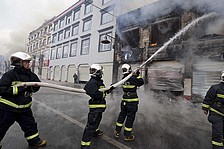
The Tibetan government in exile, based in the north Indian town of Dharmsala, offered no details in their statement, and quoted only "unconfirmed sources." China moved Saturday to quell the largest and most violent protests against its rule in Tibet in nearly two decades after demonstrators rampaged through Lhasa in an uprising that left at least 10 people dead. China's governor in Tibet vowed to use harsh measures and law enforcement officials ordered protesters to surrender. Lhasa's streets were mostly empty Saturday after the violence that embarrassed the communist leadership ahead of the Beijing Olympics. Baton-wielding police patrolled the smoke-wreathed capital and residents remained under curfew. Reports of deaths and arrests were varied and could not be independently confirmed. China's official Xinhua News Agency said 10 people - including two hotel employees and two shop owners - were burned to death, but no foreigners were hurt. The report did not give any other details. "We will deal harshly with these criminals in accordance with the law," said Champa Phuntsok, chairman of the Tibetan government. "Calm will be restored very soon." "Beating, smashing, looting and burning - we absolutely condemn this sort of behavior. This plot is doomed to failure," said Phuntsok, an ethnic Tibetan, speaking on the sidelines of the National People's Congress, China's annual legislative session. From Dharmsala, India, the Dalai Lama appealed to China not to use violence, saying he was "deeply concerned," and urged Tibetans "not to resort to violence." The Dalai Lama, who fled into exile in 1959 following a failed uprising against Chinese rule, is still Tibet's widely revered spiritual leader. He is reviled by Beijing, who accuses him of waging a clandestine campaign for formal independence, though he says he wants only greater autonomy in hopes of preserving Tibet's Buddhist culture. Law enforcement authorities in Tibet were offering leniency for demonstrators who surrender before Tuesday. Otherwise, they will be "severely punished," according to a notice carried on official Web sites and confirmed by prosecutors. It accused an unspecified number of lawbreakers of "killing innocent people, surrounding and beating law enforcement officers." Footage and photos sent from Lhasa provided a clearer picture of the extent of Friday's uprising. Plumes of smoke billowed from buildings and small shops scattered across several parts of the city. Fire trucks moved through mainly empty streets after dark. On Saturday, Xinhua said Lhasa had "reverted to calm" and electricity and phone service, which had been cut for parts of Friday, was being restored. "There was not much traffic on the road," the Xinhua report said. "Burned cars, motorcycles and bicycles remained scattered on the main streets, and the air is tinged with smoke." Some shops were closed but government staff were required to work, said a woman who answered the telephone at the Lhasa Hotel. "There's no conflict today. The streets look pretty quiet," said the woman who refused to give her name for fear of retribution. Tourists already in Lhasa said they were forced to stay in their hotels. Others who arrived Friday were "told to go back immediately without even being allowed to come out of the airport," said a tour guide, who did not want to be identified. Government workers said they have been prevented from leaving their buildings. "We've been here since yesterday. No one has been allowed to leave or come in," said a woman who works for Lhasa's Work Safety Bureau, which is located near the Potala Palace, the former residence of the Dalai Lama. "Armored vehicles have been driving past," she said. "Men wearing camouflage uniforms and holding batons are patrolling the streets. Calls to shops and department stores rang unanswered. Officials at Lhasa's public security bureau and government office refused to answer questions and hung up. It is extremely difficult to get independent verification of events in Tibet since China maintains rigid control over the area. Foreigners need special travel permits, and journalists are rarely granted access except under highly controlled circumstances. In contrast to the calm on Saturday, the scene Friday was reportedly very different. Eyewitness accounts and photos posted on the Internet portrayed chaos in Lhasa with crowds hurling rocks at security forces, hotels and restaurants. The US Embassy said Americans had reported gunfire. At a demonstration outside the United Nations in New York, Psurbu Tsering of the Tibetan Association of New York and New Jersey said its members received phone calls from Tibet claiming 70 people had been killed and 1,000 arrested. The reports could not be verified. Shops were set on fire along two main streets surrounding the Jokhang temple, Tibet's most sacred shrine and the heart of Lhasa's old city, sending out thick clouds of smoke. Young men set fire to a Chinese flag and a huge bonfire burned in a street. Armed police in riot gear backed by armored vehicles blocked intersections, said a Tibetan guide. The latest unrest began Monday, the anniversary of the 1959 uprising, when 300 monks from one monastery demanded the release of other monks detained last fall. But political demands soon came to the fore. Other monks and ordinary Tibetans demanded independence and unfurled the Tibetan flag. Arrests ensued, leading to more protests. |
|