|
|
|
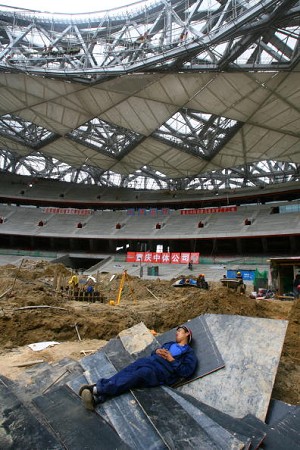
A friend of mine wrote me a letter saying that a Chinese delegation in Japan announced that the Beijing Olympics will not cost the Chinese government a penny. Though the statement sounded unbelievable, those in attendance failed to question it. Those who uttered such an absurd lie apparently considered their listeners fools. Amazed at the absurdity of the lie, I surfed the internet for relevant information regarding the subject. According to one internet site, on the afternoon of September 20, 2007, the Promotion Conference on 2008 Beijing Olympics was held at the Chinese embassy in Japan. At the conference, Yu Zaiqing, Vice Minister of State General Administration of Sports (SGAS) and Executive Vice-President of the Beijing Organizing Committee for the Games of the XXIX Olympiad (BOCOG), summarized the Olympic preparation work and current progress, and claimed, "The Beijing Olympics will not cost the government a penny." "Based on calculations by economists, the 2008 Olympics Games may advance China's GDP by 3 - 4 percent," said Yu. I believe that it is important to discuss Yu's incredible statement. Years ago economists had claimed that education industrialization could elevate GDP, and later on they did not want to talk about this issue any more. I hereby do not want to focus on the statements about GDP. Let's just take a close look at Yu's bizarre methods to calculate the expenses to host the Olympic Games. He enumerated the expenses. The Olympics will last 18 days. Regardless of the spending on the construction of gyms and infrastructure, the hosting expenses total $2.4 billion. Meanwhile, the National Broadcasting Corporation will pay $1.67 billion, 51 percent of which will be obtained by the International Olympic Committee, and 49 percent of which will be offered to the BOCOG. Additionally, there will be income from Olympic marketing, such as sales of Olympic products, stamps and donations. The total income is projected to cover the Olympic expenses of $2.4 billion. What's better, 20 to 30 million US dollars will be left, which will be used to fund a "foundation for athletes." Yu skillfully avoided mentioning spending on the construction of Olympic gyms and infrastructure, which is dozens of times higher than the hosting expenses. His statements focus only on the 18-day expense. As implied by the name, the Olympic Games expenses cover all related spending on hosting the Olympics, which can be divided into direct and indirect costs. All indirect costs, like the enormous sums of money spent on advertising and training athletes, can be removed from the "hosting expenses" for two reasons. First, a large amount of money has been used to maintain China's state-run propaganda machine, not specifically to advertise the Olympics. Second, huge sums of money have been spent on coaching athletes–the money would have been spent even if China were not to host the Games. But the direct cost of hosting the Olympics should not be excluded from the hosting expenses. First, the stupendous cost of Olympic Games venues and infrastructure construction should not be counted out of the overall expenditure. Since Beijing was awarded the 2008 Olympic Games, stadiums have been built on a large scale. The Chinese government funded all of the Olympic venues as national projects, on its political premise of "Everything is for the Olympic Games." However, the original budget of 17 billion is far less than the expected total expenses. As early as 2004, there was news that the building cost of stadiums generally exceeded budget. BOGOC executive member, Wei Jizhong, revealed that only the actual cost of 2008 Olympic Games main venue, National Stadium (commonly known as bird's nest), exceeded the budget by 50 ~ 70 percent. Some experts pointed out that the pursuit of greatness, novelty, foreign flavor has brought up the safety and waste issue to the construction of 2008 Olympic venues. Second, the investigation expenditures that are used by the government to train its officials should be included in the direct cost of Olympic Games. The State Sports Commission has sent 100,000 officials abroad to learn how to host the Olympic Games, and this doesn't include the large number of officials that were sent to the 2004 Athens Olympic Games. All of these expenses undoubtedly should be listed as Olympic Games expenses. Third, the huge subsidies for the cultivation of "Olympic Pig," "Olympic Fruit," and "Olympic Vegetable" should not be removed from the Olympic expenses. The "Olympic Pig", "Olympic Fruit" and "Olympic Vegetable" are products specially designed to meet international standards, without consideration for the production costs. Based on the disclosed design methods, the production costs are far beyond those of similar products. However, the selling price will remain the same to "international visitors," as Chinese authorities will always use the country's resources to maintain international image. So, it's safe to infer that the high subsidies to farmers can only be granted by the authorities. Obviously, these costs should be considered as Olympic expenses. Finally, there is another kind of "expense" that the Chinese authorities are exceptionally reluctant to admit, which is the survival rights of the millions of the residents in Beijing, and the farmers in the suburbs, who lost their homes and land to Olympic Games venues. According to a survey conducted by the Centre on Housing Rights and Evictions in Geneva, over 1 million Beijing residents have been forced to relocate, and this number will increase to 1.5 million by 2008. It is the forced "rendition" of these Beijing residents that dramatically lowered the land price of the Olympic Games stadiums and the overall cost of the Olympic Games. From the brutal persecution of a small number of defenders, such as Ye Guozhu's family, we can imagine how many human rights tragedies have happened—and this loss cannot be directly measured with money. The costs of the Olympic Games are well known. However, in front of the hard facts, the shameless lies of Chinese officials have made despair all who hope to maintain stability in China. |
|